
Look, if you’re in marketing then you’re familiar with the “refounding” of HubSpot going down right now.
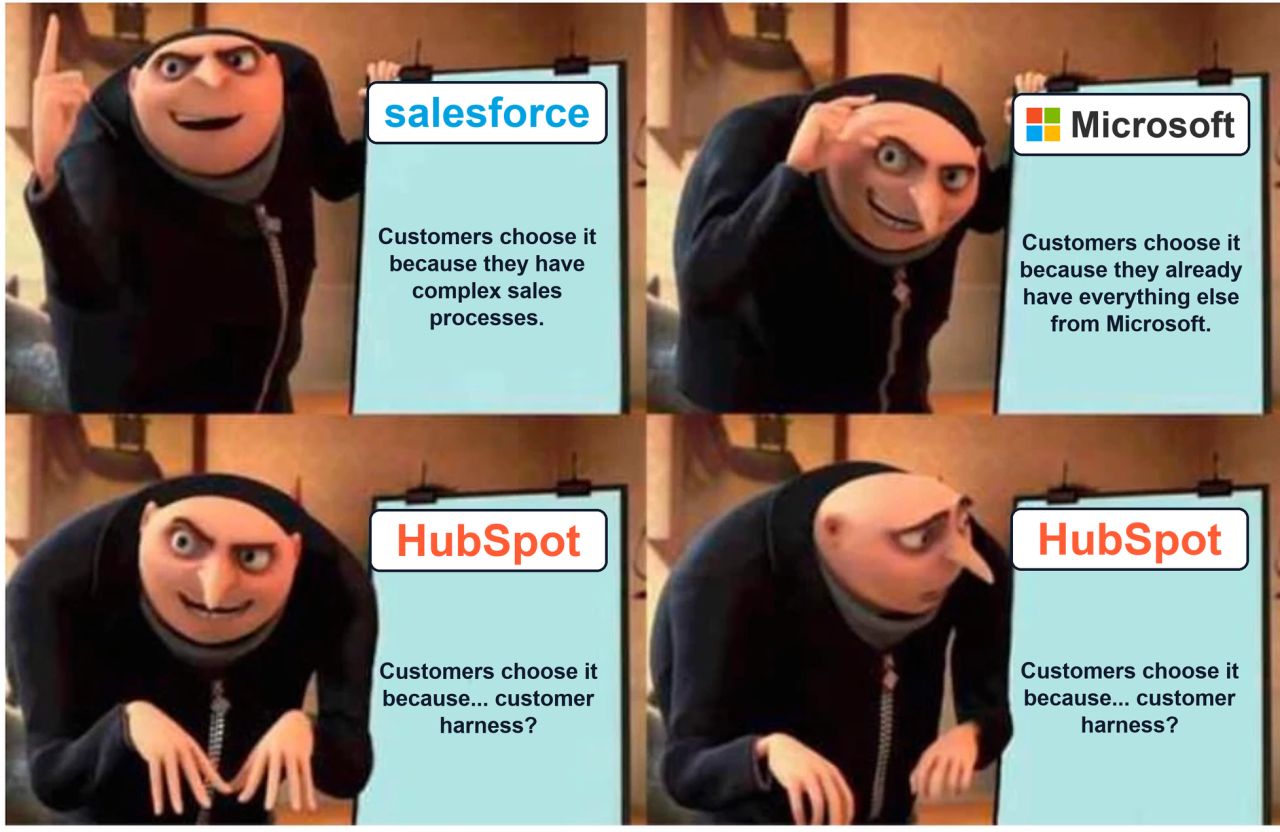
I’m not here to pile on more commentary on the “customer harness” word choice. It’s a bit rough.
…I’m here to explain why this is a huge opportunity for the agencies selling into HubSpot’s midmarket customer base.
20 years ago, my friend Brian and I founded HubSpot. We were in a tiny office right at CIC (iykyk) on the MIT campus where both of us met and had gone to grad school. (shown below). Today, 20 years later, we are refounding HubSpot. Thrilled to share that @bhalligan is returning…
— dharmesh (@dharmesh) November 12, 2026
Key Takeaways
- HubSpot has 311,704 customers paying an average of $12,038 a year. Most are SMBs that barely tap the marketing automation features of the product.
- Using it properly takes a $100K+ marketing ops hire, which a $3M company can't fund. That's why marketing automation tools like Marketo continue to thrive upmarket and left so much space for Hubspot and vertical CRMs to come in on the lower end.
- Agents doing the operating means one marketer can run ten clients at similar level of service they'd have with an in-house $100K+ hire. Scenario: at $2K a month per client, the client saves $100K a year and the marketer running them bills $250K.
- We've already seen this start to play out among paid media agencies in 2026, since AI creative and integrations between Claude and ad platforms enables scale that was impossible just two years ago.
- HubSpot is going to spend a TON of money to push the same model on midmarket customers, which will massively accelerate the existing trend towards downmarket adoption of sophisticated marketing automation built on headless CRMs.
- Small agencies with strong marketing fundamentals are going to make an absolute fortune selling into this trend.
Who actually pays for HubSpot
From the Q3 earnings call on November 4, a week before the refounding:
- 311,704 customers, up 12%, with 5,300 added in the quarter and guidance for under 5,000 in Q4
- $12,038 average subscription revenue per customer
- 101% net revenue retention, customer dollar retention “in the high 80s”
- Yamini Rangan, in her last call as CEO: “Down market, customers are more price-sensitive and focused on optimizing costs.”
$12,038 a year is about $1,000 a month, which is a Starter or low-tier Pro subscription with a few seats. HubSpot doesn’t publish the mix, but the math says the typical customer is a small company. A $120K deal is a big deal for them (they called out that cohort growing 19%).
The stat that gets passed around is that 43% of CRM customers use fewer than half of what they pay for. That’s from a HubSpot trainer on a podcast, so take it for what it is. But I’ve been inside a lot of small-company HubSpot portals and it’s the same every time: a contact list, a form, maybe a newsletter, and a deals board sales stopped updating in month three. No lifecycle stages, no scoring, reports tab never opened.
…And that’s not because the owners are lazy. The product is designed to be operated by somebody, and they don’t have that somebody.
The $125K problem
Running a real marketing ops setup, at any company size, means somebody has to:
- Decide what a lead is in this business, what makes it an MQL rather than a form fill, and when sales has to accept it as an SQL.
- Build lead scoring, then rebuild it when sales says the scores are wrong.
- Define lifecycle stages and get sales to actually use them.
- Write the sequences (new lead, no-show, closed-lost, win-back, at minimum).
- Route leads to the right rep (or SDR, if there is one) in minutes, not days, and put an SLA on the follow-up so it actually happens.
- Keep the CRM in sync with the invoicing tool, the phone system and the booking software.
- Build the weekly pipeline report and explain to the owner why attribution is lying.
- Notice when a workflow has been broken for three weeks and nobody told you.
That’s a marketing ops manager, $90K to $140K depending on the city, call it $125K loaded. It’s the same reason Marketo never went downmarket: the software was never the expensive part, the person was.
A $3M HVAC company with 12 employees nets maybe $300K in a good year. A $4M professional services firm might net $600K. Spending $125K on a marketing ops hire is 20% to 40% of profit, and the owner has no way to tell a good one from a bad one. So they don’t, and they keep paying $1,000 a month for a contact list.
Fractional doesn’t fix it either. A fractional ops person charges $3K to $5K a month and tops out at three to five clients, because most of the job is operating: clicking through HubSpot to build the thing that was already decided. The deciding is a day a week. The clicking is what caps the client count.
What changes with the harness
If the agent does the clicking (and customers already are: 22 million CRM objects created through the Claude and ChatGPT connectors last quarter, up 157% from Q2), the marketer’s week flips. Deciding is still a day per client. Execution drops to a few hours of reviewing what the agent built and fixing what it got wrong.
So one person runs ten clients instead of three. Scenario: charge each one 20% of the in-house hire, $25K a year, about $2K a month.
| Per client | One marketer, 10 clients | |
|---|---|---|
| In-house marketing ops hire | $125,000/yr | |
| Agency fee (20%) | $25,000/yr | $250,000/yr |
| Client saves vs. hiring | $100,000/yr | |
| Agent/software cost | ~$200 to $500/mo | $24,000 to $60,000/yr |
The client gets the setup a $50M company has for less than their HubSpot bill. The marketer clears around $200K after software. And it undercuts today’s fractional pricing by 30% to 60%, which is the point: nobody can offer that price unless the agent is doing the clicking.
How big the market is
Napkin math, assumptions shown so you can argue with them.
Say half to 60% of HubSpot’s 311,704 customers are small companies with no ops person and a portal that’s mostly a contact list. That’s 150,000 to 190,000 portals. At $25K a year each:
- 150,000 × $25,000 = $3.75B a year
- 190,000 × $25,000 = $4.75B a year
At $250K per marketer, that’s room for 15,000 to 19,000 of them, in small agencies or on their own. Sanity check from the other direction: HubSpot’s subscription run-rate is about $3.75B and services around a platform usually land at one to two times license spend, so $4B to $7B is the right neighborhood.
That’s HubSpot only. HubSpot is about a third of the SMB CRM market per Ramp’s spending data, and Salesforce (Headless 360, April), Klaviyo (headless launch in September, 260 MCP tools), Attio and Zoho are all opening the same access. Count every small company with an underused CRM and you’re at $12B to $15B.
I’ll take the under for the next two years, because small companies move slowly and most of those 17,000 agencies don’t exist yet. The shape is the point, not the decimal.
Paid media already did this
…If this sounds speculative, look at PPC agencies. The shops I like for paid media are six to ten people running accounts spending $5K to $150K a month with the founder in every account. In 2020 that book of business took 20 to 30 people, because somebody had to sit in Google Ads and Meta all day pulling levers.
Google and Meta went headless before anyone used the word. The senior person describes what they want in Claude or ChatGPT, the integration makes the changes, the human reviews. An ad manager who handled five accounts handles fifteen. Fee minimums came down ($1,250 a month is a normal starting point now) and clients per person went up.
Second-order effect: most of the local SEO agencies I talk to now sell paid media as their main service, because a two-person shop can run paid for 20 clients through those integrations and can’t run SEO for 20 clients at any price. The service followed the tooling.
Marketing ops is about three years behind paid media on this curve, with one big difference: nobody spent real money telling small businesses to let an agent run their Google Ads. HubSpot spent $401.6M on sales and marketing in Q3 alone, 42% of revenue, and $1.19B in the first nine months of 2026. A founder came back specifically to point that budget at the agent story. Every dollar of it is free marketing for the agency that can actually deliver.
What the small agency actually sells
For $2K a month, with the agent doing the build, the deliverable to a $3M client is:
- Lifecycle stages and lead definitions, written down, agreed with whoever does sales
- Lead scoring built on the client’s actual close history, not a template
- Routing that gets a new lead to a human within 15 minutes during business hours
- Four or five sequences: new lead, no-show, quote sent, closed-lost, past customer
- The CRM in sync with the booking tool, the phone system and the invoicing software
- A weekly pipeline email the owner can read in two minutes
- A monthly call to look at what’s leaking and change something
That’s roughly what a $50M company’s marketing ops team produces, minus the dashboards nobody reads. It’s also what a marketing automation platform like Marketo was always for, at a price point Marketo has never been able to reach.
There are 150,000+ HubSpot portals waiting for someone to run them properly at a price the owner can say yes to, and HubSpot is about to spend a fortune telling those owners it’s possible. The agencies that can actually deliver it are going to have a very good few years.
 Best AI Receptionists for Small Business (2026)