
Marketing Definition of "Influencer Whitelisting"
Influencer whitelisting is when a creator gives a brand permission to run paid ads from the creator's own social media account. The ad shows the creator's name and profile picture at the top, so it looks like the creator is recommending the product. Behind the scenes, the brand pays for the ad, picks who sees it, and manages it from its own ad account. Meta's official name for the feature is "partnership ads" (formerly "branded content ads"); on TikTok it is called "Spark Ads."
What influencer whitelisting means in plain English
Open Instagram and scroll until you hit an ad. Look at the top left corner. Normally you see the brand’s logo and name, then “Sponsored” underneath.
Now imagine that same ad, same product, same button, but the name at the top is a person. A fitness coach. A mom who reviews strollers. A niche website. The word “Sponsored” is still there, but the brand’s own account is nowhere on the ad.
That is a whitelisted ad. The creator lent the brand their name and face. The brand paid for the ad, chose who sees it, and is running it from its own ad account.
The word comes from “whitelist,” the old IT term for a list of approved accounts. The creator adds the brand to their approved list, and from then on the brand can run ads that look like they came from the creator. Meta now calls the feature partnership ads (it used to be branded content ads), and TikTok calls it Spark Ads. Marketers still say whitelisting for all of it.
Why brands bother
People trust people. A recommendation from someone who seems independent beats a pitch from the company selling the thing, and ad platforms know it. Meta’s own guidance says to use the creator-only format “when the partner is authentically promoting their use of a product or service.”1
Three things make whitelisting more than a nice-to-have:
- The ad reaches strangers. The brand targets the ad like any other ad. The creator’s followers are a rounding error. What the brand is really buying is the creator’s name on an ad shown to millions of people who have never heard of either of them.
- The ad can run for years. An organic post from a creator dies in a day. A whitelisted ad runs as long as the brand keeps paying. The hair-loss brand Keeps ran one whitelisted ad for over two years and it stayed the best performer in their account the whole time.2
- It fixes ad fatigue. Your own ads all look like you. A handful of creator handles gives you a dozen different “senders,” which Meta treats as fresh creative.
The two formats, and why most explanations get this wrong
Most articles treat whitelisting as one thing. It is two, and they look different in the feed. Meta’s Ads Manager lets the advertiser choose how many account handles (Meta calls them identities) appear in the ad header.1
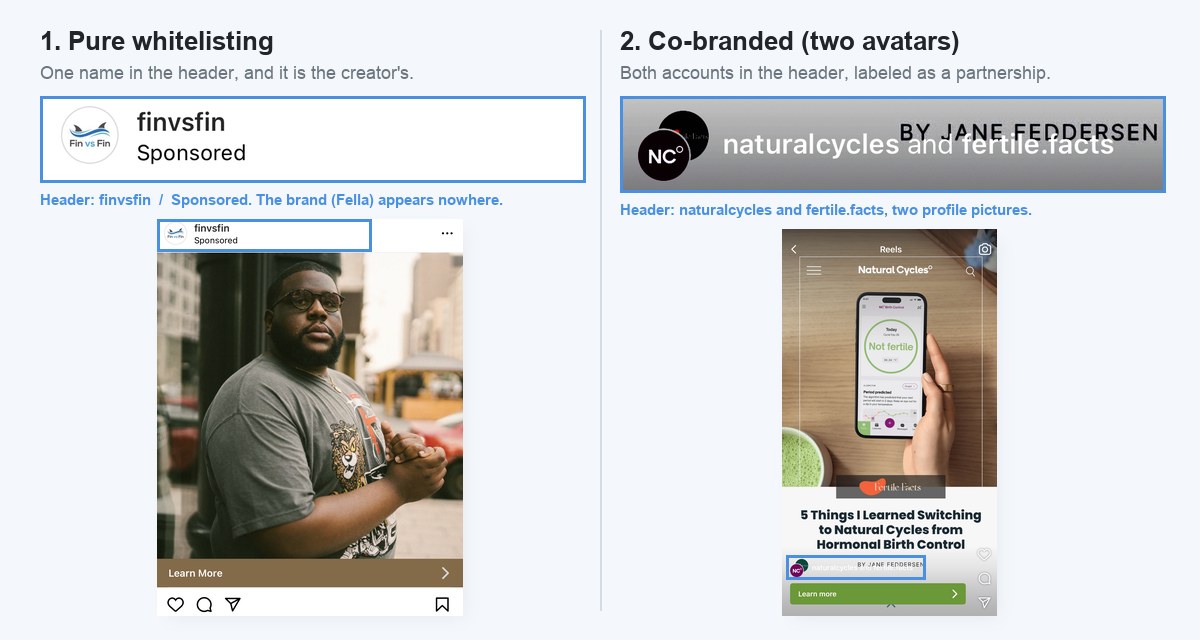
1. Pure whitelisting: one name, the creator’s
Only the creator’s handle and profile picture appear. Meta calls this the “Partner (creator) only” option. The brand’s account does not show anywhere in the header; the only clue is the “Sponsored” tag and the fact that the button leads to the brand’s site.
A real example. Keeps, the hair-loss subscription, ran ads from the handle of finvsfin, a product-review site. The header reads “finvsfin · Sponsored.” The video shows the site’s founder holding up his phone with a “Get 50% off your first three months” banner and a “Learn More” button pointing to Keeps. Keeps’ own account never appears. Over two years that ad ran at roughly 46% lower cost per acquisition than the brand’s own ads and a 6.6x return on ad spend, on more than $100,000 of monthly spend.2
This is the version with the biggest “wait, is that an ad?” effect, and the version most people mean when they say whitelisting.
2. Co-branded: two avatars, “creator with Brand”
Here the header shows two overlapping profile pictures and both names. In the example above, a Natural Cycles reel runs with “naturalcycles and fertile.facts” under the two avatars, and the clickthrough goes to a Fertile Facts article titled “5 Things I Learned Switching to Natural Cycles from Hormonal Birth Control.” Meta calls this “Both advertiser and partner (creator).” You will also hear it called a collab ad or a co-posted ad, because it looks like Instagram’s Collab post feature.
This was the only format Meta offered until mid-2025, when it added the creator-only header and a third setting, dynamic identity, that lets Meta pick one or two names per impression based on what performs.3 Meta recommends dynamic identity as the default.1
The co-branded version is more honest at a glance, and it borrows credibility from both names at once. It is also the format that larger ad networks run as a service: GoLoot, for example, places brand offers through established publisher pages (Canadian outlets like Narcity and Daily Hive sit in its network) and charges per click or per lead rather than a management fee.4 You are not negotiating with a creator; you are buying placement from a network that already has the publisher relationships.
What whitelisting is not
Two things get confused with it constantly:
- Buying usage rights to a creator’s video and running it from the brand’s own account. The content is the creator’s, but the name at the top is the brand’s. That is just a brand ad with UGC creative. No permission from the creator’s account is involved.
- A creator’s own post with a “Paid partnership with Brand” label. That is branded content, which is a disclosure, not an ad. It becomes a whitelisted ad only when the brand puts money behind it from Ads Manager.
How the permission actually works
The creator never hands over a password. Here is the whole flow, simplified.
On Meta (Instagram and Facebook). There are two levels. At the account level, the brand sends a request from Meta Business Suite (Creator Marketing, then Manage permissions, then Add partnership) and the creator accepts it in the Instagram app.5 From then on the brand can run ads from that creator’s handle without asking again, with or without an existing post. At the content level, the creator approves one specific post, story or reel, often by generating a partnership ad code in the Instagram app and sending it to the brand, which pastes it into Ads Manager.
On TikTok (Spark Ads). The creator turns on ad authorization in their settings, picks a specific video, chooses how long the permission lasts (30 days is the default, up to a year), and gets a code. The brand enters the code in TikTok Ads Manager and can then run that video as an ad from the creator’s handle. When the code expires, the ad stops.6
In both cases the creator can revoke access, and the brand only ever gets to run ads, not read messages or change the profile.
Publisher whitelisting: the same trick with a website’s handle
A “creator” does not have to be a person. A niche review site or small publication with an Instagram or Facebook page works the same way, and for some products it works better, because a site called Fertile Facts or Review Clinic reads as an institution rather than an individual.
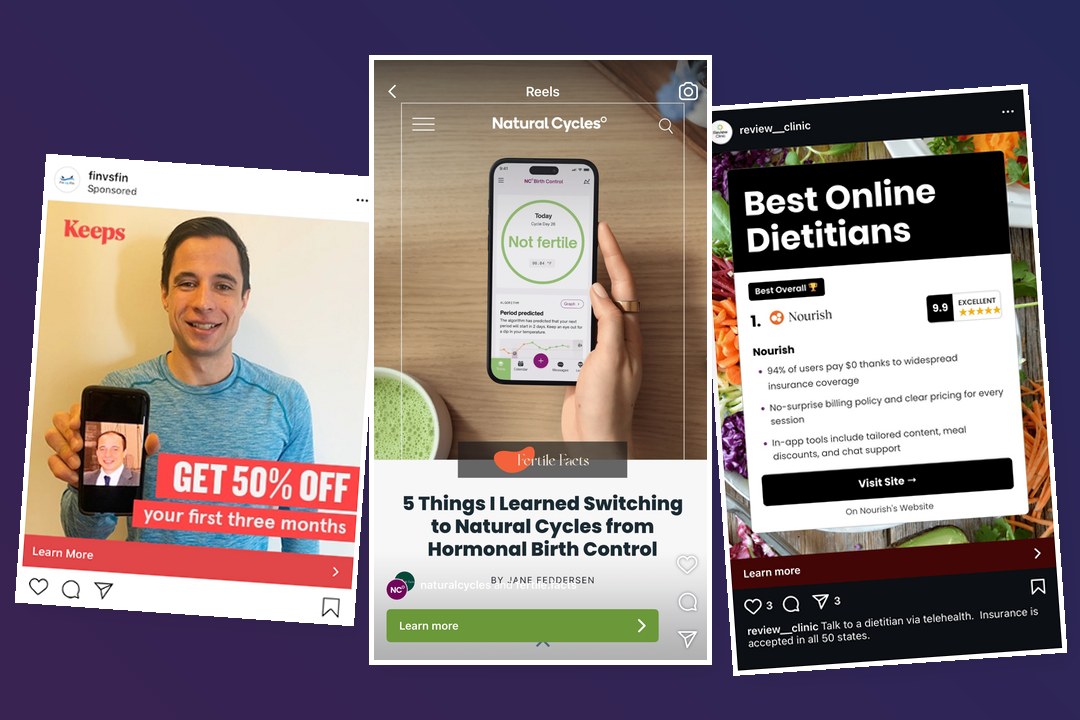
Authority Genius, which specializes in this, has published three cases worth studying because they show the full pattern, including where the click goes:2
- Beli (prenatal vitamins) ran ads from fertile.facts. The creative is a stars-and-verdict card: “Our verdict: Beli is our choice for best men’s fertility vitamin,” with a “Shop now” button. The click went to a review article or a top-5 list on FertileFacts.com, and from there to Beli. Result: 22% lower CPA and 4.8x return on ad spend on $25,000 or more a month.
- DietSmoke (CBD sleep gummies) ran ads from review__clinic with both logos inside the creative. One is a testimonial card (“Best sleep ever.”), the other is a “wine before bed vs. gummy before bed” comparison. CBD is a hard category to advertise, so a third-party reviewer’s name on the ad mattered. Result: 18% lower CPA, 4.2x return.
- Keeps, described above, is the pure one-name version.
Notice the shape of the good ones: the ad does not say “buy this.” It says “we reviewed this,” which is what a reader expects from that sender. The ad matches the name on it. Bad whitelisted ads are brand ads with a creator’s name pasted on top, and audiences see through them in a second.
Usage example
We’re not going to film new UGC for Q4. Let’s whitelist the two creators whose reviews already convert and put the budget behind their handles instead.
Synonyms and related terms
- Creator whitelisting, allowlisting (the newer, same-meaning term)
- Partnership ads (Meta’s current name), branded content ads (Meta’s old name)
- Spark Ads (TikTok)
- Publisher whitelisting (a site’s or publication’s handle instead of a person’s)
- Co-branded ads, collab ads (the two-avatar format)
- Handle rental, creator licensing (what the creator side calls it)
- Dark posts are often mentioned alongside whitelisting but are different: a dark post is an ad from the brand’s own page that never appears on the brand’s feed.
-
Meta. “About displaying accounts in partnership ads header.” Instagram Help Center. https://help.instagram.com/1473177953902613/ Lists the three identity options: “Both advertiser and partner (creator),” “Partner (creator) only,” and “Dynamic identity,” and notes that ranking uses signals from both accounts regardless of which is shown. ↩ ↩2 ↩3
-
Authority Genius. “Case Studies & Whitelisting Success Stories.” https://authoritygenius.com/case-studies/ Keeps, Beli and DietSmoke results as published by the agency that ran the campaigns; figures are the agency’s own reporting. See also Alex Goldberg, “Publisher Whitelisting 101: How does it work?” https://authoritygenius.com/publisher-whitelisting-101-how-does-it-work/ ↩ ↩2 ↩3
-
Meta for Developers. “Partnership Ads API: New Features.” July 8, 2025. https://developers.facebook.com/blog/post/2025/07/08/partnership-ads-api-new-features/ “Businesses can now feature one partner in the ads header… rather than previously having to feature the partner + business.” ↩
-
Goloot. https://goloot.io/ Describes a network of 150+ publisher sites, flat CPC or CPL pricing with no management fees; Awin’s partner profile, https://www.awin.com/us/affiliate-marketing/goloot-content-partnerships, describes the Meta product that lets brands advertise from publisher pages. ↩
-
Meta. “Manage account-level permissions for partnership ads in Creator Marketing Hub.” Instagram Help Center. https://help.instagram.com/966886840676703 ↩
-
TRIBE. “How to use an authorization code in TikTok Ads Manager.” https://help.tribegroup.co/en/articles/6843741-how-to-use-an-authorization-code-in-tiktok-ads-manager Third-party walkthrough of the Spark Ads code flow; check TikTok’s own help center for current duration options. ↩
Frequently Asked Questions
Is influencer whitelisting the same thing as partnership ads?
Mostly, yes. Partnership ads is Meta's name for the feature that makes whitelisting possible on Facebook and Instagram. Whitelisting is what marketers have called the practice since before Meta had a product name for it. The one wrinkle is that a partnership ad can show either the creator alone or the creator and the brand together, and some marketers only use the word whitelisting for the creator-only version. If someone says whitelisting, ask which header format they mean.
Does the brand get access to the creator's account?
No. The creator never shares a password. On Meta, the creator approves a request in the Instagram app (or sends a one-time partnership ad code for a single post), and the brand then sees that creator's handle as an option inside its own Ads Manager. On TikTok, the creator generates a Spark Ads authorization code for one specific video, with an expiry date, and the brand pastes that code into TikTok Ads Manager. The creator can switch the permission off at any time, and when a TikTok code expires the ad stops running.
Do whitelisted ads only reach the creator's followers?
No, and that is the point. The brand targets the ad like any other ad: lookalikes, interests, retargeting, whatever it wants. The creator's followers are usually a small slice of the people who see it. Meta even lets the advertiser include or exclude the creator's existing audience. A creator with 8,000 followers can front an ad that reaches 2 million people.
What does influencer whitelisting cost?
Two separate bills. First, the creator or publisher gets paid for lending their handle, usually a flat monthly fee (a few hundred dollars a month is common for smaller accounts) or a cut of each sale the ad produces. Second, the brand pays Meta or TikTok for the ad spend itself, exactly as it would for any ad. If an agency sets it up, there is a setup or management fee on top. As an example of published agency pricing, Authority Genius lists $1,500 setup plus $500 a month for access to one publisher handle as of October 2026.
 ICP (Ideal Customer Profile): Definition and Meaning